Stem cell skincare is everywhere, but how much of it is backed by real science? Some creams promise to erase wrinkles and boost collagen, but are they actually effective, or just another marketing gimmick?
The truth is, not all “stem cell” creams actually do what they claim. Some formulas contain powerful regenerative ingredients like exosomes and conditioned media, while others rely on plant extracts that might not be as effective.
We’ll break down the different types of stem cell skincare, explain what actually works (backed by science) and show you how to spot the fakes. Plus, we’ll review some of the best stem cell creams and serums that are actually worth your money.
What is Stem Cell Cream or Stem Cell Skincare?
Stem cell creams are a skincare product made with ingredients taken from stem cells that boost collagen and stay firm and smooth.
But here’s the catch: they don’t actually contain live stem cells. Instead, they use bioactive ingredients derived from stem cells, like conditioned media, exosomes and growth factors, to mimic the way real stem cells support healing
These ingredients act like messengers, telling your skin to boost collagen and elastin production. (Collagen keeps your skin firm and smooth, while elastin helps it stay bouncy and flexible.) Unlike regular moisturizers that just sit on the surface, these bioactive ingredients actually signal your skin cells to act younger, improving texture, reducing wrinkles, and strengthening your skin over time
However, they don’t regenerate new skin cells the way actual stem cell therapy or injections would. Rather, they help optimize the function of your existing ones.
Here’s a quick guide to the different types of stem cell-based skincare: what they do, how they work and which ones are worth your money:
| Category | Definition | Characteristics |
| Exosome-Enriched Stem Cell Conditioned Media (Most Advanced) | Highly purified exosomes. Tiny messengers filled with repair signals, proteins, and growth-supporting molecules. Derived from stem cells. | The most advanced option for skin regeneration and repair. Delivers high concentrations of growth factors, cytokines, and genetic material (mRNA & miRNA). Absorbs deeper into the skin for enhanced anti-aging and healing effects. |
| Stem Cell Conditioned Media | A nutrient-rich fluid collected from live stem cell cultures, containing growth factors and cytokines. | Helps boost collagen production and speed up skin repair. Naturally contains some exosomes, but not as concentrated as purified exosome serums. |
| Bioactive Stem Cell-Derived Complex | A refined extract of specific proteins and molecules from stem cells, without the full range of exosomes and growth factors. | Contains fibronectins, glycoproteins, albumin, and hyaluronic acid (HA). Lacks the complete mix of exosomes and cytokines needed for maximum regeneration. |
| Stem Cell Extracts (Including Plant-Derived Extracts) | Processed extracts from either human or plant stem cells, but without active growth factors or bioactive molecules. | Doesn’t contain live regenerative molecules,just proteins, antioxidants, and hydration benefits. Most plant-based stem cell extracts focus on protecting and hydrating the skin rather than regenerating it. |
Do Stem Cell Creams Really Work?
Yes, some stem cell creams actually do work! But only if they contain the right ingredients, like exosomes or conditioned media. These formulas can boost collagen production and support skin repair, but they don’t create new skin cells. Many products labeled as ‘stem cell’ skincare only use plant extracts, which provide antioxidants & can moisturize but don’t regenerate skin.
There’s a lot of marketing around “Stem Cell” Creams, so you definitely need to be careful when you’re in the market.
How do Stem Cells work in Creams?
Stem Cell creams with the right formulas can boost collagen production and support skin repair, but they don’t create new skin cells. Many products labeled as ‘stem cell’ skincare only use plant extracts, which provide antioxidants & can moisturize but don’t regenerate skin.
Here’s a breakdown on the Stem Cell ingredients and how they work in creams:

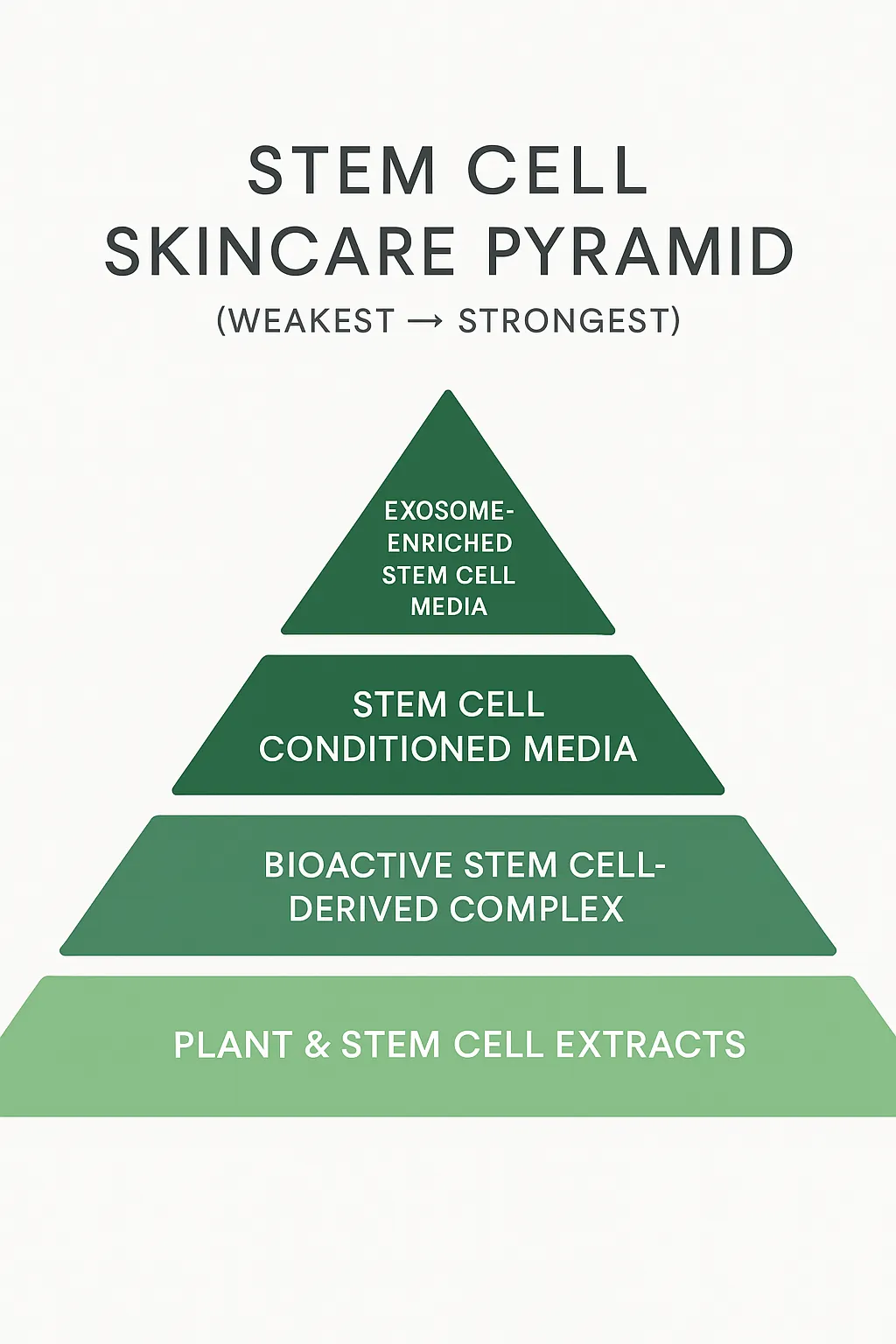
🔬 Exosome-Enriched Stem Cell Media
Effectiveness: ★★★★★★ (Gold Standard)
The most advanced option in stem cell skincare. Exosomes act like tiny messengers, delivering powerful repair signals deep into your skin to boost collagen, accelerate healing, and trigger regeneration.
- 6-week clinical study showed reduced wrinkles, redness & hyperpigmentation
- Improves skin tone, hydration & elasticity faster than any other ingredient
- Considered the gold standard for regenerative skincare
💰 Price Range: $$$$ (Premium)
📊 Science Level: Strongest clinical backing
Examples of Products:
- Ultimate Serums (RevivSerums): Human Fibroblast Conditioned Media + Bone Marrow Exosomes
- RevivHair Exosome Therapy: Hair follicle stem cell media + bone marrow exosomes
⭐ Stem Cell Conditioned Media
Effectiveness: ★★★★★
A nutrient-rich liquid collected from cultured stem cells, packed with growth factors that support skin repair, collagen production, and anti-aging.
- 28 day trial showed improvements in hydration and brightness
- Reduces wrinkles and firms skin with higher concentrations
- Best used in advanced anti-aging regimens
📊 Science Level: Strong clinical backing
💧 Bioactive Stem Cell-Derived Complex
Effectiveness: ★★★☆☆
A blend of stem cell proteins, hydration boosters and repair molecules. Not as potent as conditioned media but stronger than plant extracts.
- Improves hydration and skin barrier strength
- Supports repair but lacks full regenerative power
📊 Science Level: Moderate
🍃 Plant & Human Stem Cell Extracts
Effectiveness: ★★☆☆☆
Often seen in “stem cell creams,” these provide antioxidants and hydration but don’t regenerate skin cells like conditioned media.
- Protects skin from environmental stress
- Boosts hydration and barrier strength
- Does not stimulate collagen, regnerate skin cells or reverse deep wrinkles
📊 Science Level: Low (mostly cosmetic benefits)
- The six-week clinical study on Exosome-Enriched Stem Cell Conditioned Media was published in Frontiers
- 28-day clinical study on Stem Cell Conditioned Media was published on BMC
- We reviewed 8 scientific papers and 10 studies on the effects of plant stem cell extracts in skincare. If you’re curious, check out this one and this one. Or we’ve broken it all down for you here!
The biggest confusion? Stem cell extracts vs. conditioned media. Extracts are just processed proteins from stem cells, while conditioned media contains the actual growth factors and signals that help skin repair itself.
You can spot the difference by checking the label. Stem cell conditioned media will usually have “Conditioned Media” in the ingredients list (like Human Adipose-Derived Stem Cell Conditioned Media), while stem cell extracts are often labeled as Stem Cell Extract or Callus Culture Extract
Why Most Stem Cell Creams Don’t Contain Real Stem Cells
If you’ve seen a cream claiming to have live stem cells, here’s the truth: it’s marketing hype. Live stem cells can’t survive in a skincare product and even if they could, they wouldn’t do what you think. Here’s why:
1️⃣ Stem Cells Are Alive: But they can’t “live” in Stem Cell Creams
Stem cells are living cells that need specific conditions (like temperature, oxygen levels, and nutrients) to stay alive. The moment they’re bottled into a cream or serum, they die. Long before they ever reach your skin.
2️⃣ Even If They Were Alive, They Wouldn’t Work Topically
Let’s say, hypothetically, you could put living stem cells in a jar. Even then, rubbing them on your skin wouldn’t do anything. Stem cells need to be injected or implanted, not applied topically.
What Skincare Brands Actually Mean by “Stem Cells”
Since real stem cells aren’t an option, brands use ingredients derived from stem cells instead, like:
- Exosomes – Tiny messengers that deliver regenerative signals to the skin.
- Conditioned media – The nutrient-rich fluid collected from stem cells.
- Growth factors – Proteins that help repair and stimulate collagen.
- Plant stem cell extracts – Which don’t function like human stem cells at all.
The FDA Doesn’t Regulate “Stem Cell” Skincare Claims
Since these products aren’t classified as drugs, brands can use loose wording like “stem cell technology” without real proof. This leads to overpriced serums that sound high-tech but don’t deliver real regenerative effects.
If a brand claims their product contains live stem cells, it’s misleading. The best options are exosome-based skincare or conditioned media for actual skin regeneration. Because they contain the molecules that actually help with skin regeneration. Plant & human based Stem Cell Extracts are still good for moisturization!
What are the best types of Stem Cell Creams?
The best stem cell creams for actual skin regeneration contain Exosome-Enriched Conditioned Media Or Stem Cell Conditioned Media. They contain growth factors and signaling molecules that actively repair and rejuvenate skin.
- Bioactive Stem Cell-Derived Complex ingredients are good for supporting skin health but lack full regenerative effects.
- Plant-Based Stem Cell Extracts? They work for hydration & antioxidants, but won’t actually repair skin.
How to Read labelling on Stem Cell Creams
Ever looked at the ingredients list on a fancy stem cell cream and felt completely lost? You’re not alone. Skincare brands love to throw in scientific-sounding terms, and some even use “stem cell technology” as a buzzword to justify high prices without actually including anything regenerative.
That’s why we’re breaking it down without the fluff. Below, you’ll find a simple guide to what these ingredients really mean, how they appear on packaging, and what they actually do for your skin. Whether you’re looking for real regenerative benefits or just want to avoid getting tricked by marketing, these are the key ingredients to look for.
| Ingredient | How It Appears on Packaging | How It Helps Your Skin |
| Exosome-Enriched Stem Cell Conditioned Media | Human Stem Cell-Derived Exosomes, MSC-Derived Exosomes, Umbilical Stem Cell Exosome Serum, Exosome Liposomes | Sends powerful repair signals to skin cells, boosting regeneration, collagen production, and deep healing |
| Stem Cell Conditioned Media | Human Mesenchymal Stem Cell Conditioned Media, Adipose Stem Cell Conditioned Media, Fibroblast Conditioned Media, Human Umbilical Cord-Derived Conditioned Media | Stimulates collagen production, speeds up wound healing, and improves skin elasticity over time |
| Bioactive Stem Cell-Derived Complex | Fibronectins, Collagens, Albumin, HA from Stem Cells | Helps with hydration, elasticity, and skin structure, but doesn’t have the full regenerative power of conditioned media |
| Plant Stem Cell Extracts | Malus Domestica (Apple) Stem Cell Extract, Argania Spinosa Callus Culture Extract, Vitis Vinifera (Grape) Stem Cell Extract, Camellia Sinensis (Green Tea) Callus Extract | Protects skin from environmental damage and helps with hydration but won’t regenerate skin like human-derived ingredients |
| Human Stem Cell Extracts | Human Stem Cell Extract, Human Adipose-Derived Stem Cell Extract, Human Fibroblast Extract | May contain some proteins and amino acids, but lacks the full regenerative effect of conditioned media |
| Animal-Derived Stem Cell Extracts | Hydrolyzed Horse Placenta, Hydrolyzed Sheep Placenta, Bovine Amniotic Fluid Extract, Hydrolyzed Swiftlet Nest Extract | May provide skin-nourishing compounds that support collagen production, but lacks the potent regenerative properties of human-derived exosomes |
| Fruit-Derived Stem Cells | Pyrus Malus (Swiss Apple) Fruit Cell Culture Extract, Cucumis Sativus (Cucumber) Fruit Extract, Solanum Lycopersicum (Tomato) Fruit Extract | Helps with hydration and shields against oxidative stress, but doesn’t trigger real skin repair |
Other Ingredients to Look For in Stem Cell Creams
Here are other ingredients to look out for in stem cell creams and what they do:
| Ingredient | How It Appears on Packaging | How it works |
| Hyaluronic Acid | Sodium Hyaluronate, Hydrolyzed Hyaluronic Acid, Cross-Linked Hyaluronic Acid | Provides deep hydration & plumps the skin |
| Peptides | Palmitoyl Tripeptide-1, Acetyl Hexapeptide-8, Copper Peptides, Oligopeptide-24 | Boosts collagen production, reduces wrinkles |
| Ceramides | Ceramide NP, Ceramide AP, Ceramide EOP, Phytoceramides | Strengthens the skin barrier, locks in moisture |
| Growth Factors | sh-Oligopeptide-1 (EGF), sh-Polypeptide-9 (VEGF), sh-Polypeptide-11 (bFGF), TGF-β | Supports skin renewal & cell growth |
How to Spot Fake Stem Cell Skincare
Just because a cream says ‘stem cell’ on the label doesn’t mean it actually does anything for your skin. The industry is packed with misleading claims here’s how to tell what’s real and what’s just marketing hype:
If a product claims to use stem cell technology, scan the ingredients list for:
- Human Stem Cell Conditioned Media
- Exosome-Enriched Conditioned Media
- Growth Factors (EGF, bFGF, VEGF, etc.)
- Peptides That Mimic Stem Cell Activity
- If you only see Malus Domestica (Apple Stem Cell Extract) or Argania Spinosa (Argan Stem Cell Extract) you’re paying for plant antioxidants, not true stem cell-derived skincare. Plant extracts are great for moisture retention and antioxidant protection. But they don’t stimulate skin repair or collagen production like exosomes or conditioned media.
- Skincare brands mention “Stem Cell Technology” without specifying the type of stem cells used.
- Vague claims like “Inspired by Stem Cells” or “Plant Stem Cells for Regeneration.”
- No ingredient transparency.
- Overpriced for basic formulas with no bioactive ingredients.
Many companies use the term “stem cell” to imply regeneration, but most creams don’t contain actual stem cell-derived actives. The most misleading claims come from brands that:
- Market plant stem cells or human stem cell extracts as being just as effective as conditioned media or exosomes.
- Use conditioned media or exosomes in tiny, ineffective concentrations.
If you want real skin-repairing and rejuvenating benefits, look for human-derived conditioned media, exosomes, or bioactive peptides. When in doubt, read the ingredients, check for clinical backing, and avoid vague, overhyped claims.
 Watch on YouTube
Lance Alstodt, Chairman and CEO of BioRestorative Therapies — currently running a Phase 2 clinical trial for an autologous stem cell product for chronic lumbar disc disease & in the process of Launching Cosmetic Regenerative Products, explains why the vast majority of stem cell skincare marketing makes claims the science simply does not support.
Watch: Why Most Stem Cell Skincare Marketing is Misleading →Are Stem Cell Creams Better Than Stem Cell Therapy?
No. Stem Cell Creams aren’t better then Stem Cell Therapy, they don’t have the regenerative power of PRP or Stem Cell Treatments.
Here’s how they compare:
| Treatment | How It Works | What It Can & Can’t Do | Cost | Best for |
Stem Cell Creams (Exosomes & Conditioned Media) | Uses bioactive molecules (exosomes, growth factors) to signal existing skin cells to repair and rejuvenate. | Boosts collagen & elastin production Improves skin texture & hydration Cannot regenerate new skin cells or replace lost collagen | $$ (Affordable, ~$100-$500 per product) | Early signs of aging, hydration, and skin maintenance |
PRP (Platelet-Rich Plasma) Therapy | Uses your own blood platelets to stimulate collagen production & tissue repair. | Encourages natural skin repair Reduces fine lines, scars and hyperpigmentation Results vary; multiple sessions needed Cannot replace lost skin cells | $$$ (~$500-$2,500 per session) | Wrinkle reduction, acne scars, mild skin rejuvenation |
| Stem Cell Injections (MSC Therapy) | Injects live mesenchymal stem cells to regenerate tissue at a cellular level. | Can regenerate damaged skin cells & rebuild lost collagen. Long-term anti-aging benefits More invasive, requires medical supervision Expensive & not widely available for cosmetic use | $$$$ ($5,000-$20,000+) | Deep wrinkles, significant skin damage, long-term anti-aging |
- Stem cell creams (especially exosome-based ones) stimulate your skin’s natural repair process but won’t replace lost skin cells.
- PRP treatments help boost collagen production, but results aren’t as dramatic as stem cell injections.
- Stem cell injections are the only option that can truly regenerate skin cells, but they’re expensive and still developing in the cosmetic field.
Want to learn more about stem cell therapy for anti-aging? Check out our full guide on Stem Cell Therapy for Anti Aging Treatments which covers the whole process in more detail.
Are Stem Cell Creams worth it?
Yes, Stem Cell Creams can work if they contain exosomes or conditioned media, which actively support skin repair.
However, products with only plant or human stem cell extracts mainly offer hydration and antioxidants, not true rejuvenation. And even the advanced formula creams can’t replace lost collagen the way stem cell therapy or PRP treatments can.
Stem cell skincare is an exciting but confusing space. Some creams genuinely help with skin repair, while others are just overpriced antioxidant serums. The key is knowing what to look for, exosome-based creams and conditioned media actually work, while plant stem cell & human stem cell extracts mainly offer hydration and protection.
And then there’s the cost, true Stem Cell creams are definitely not cheap!
P.s Some links on this page are affiliate links, meaning yes, you get discounts when using our links, & we earn a small commission too. But, we only recommend products we’ve researched and can explain why we’re partnered with them!
Alt Treatment is a free, independent platform that helps you understand stem cell therapy & decide if it’s right for you.
We break down complex information into clear, honest guidance. When you’re ready, we can connect you with verified clinics that meet your needs, in the right location, and often with exclusive discounts.
There’s no charge to use our platform. No hidden fees. No pressure. Our main aim is to genuinely help you figure out if treatment is right & the best places to consider.
If you want to talk, fill out our form here & our personal concierge team will reach out.
Yes, but it depends on the type. Exosome-enriched creams and conditioned media can help stimulate collagen production and skin repair. But creams containing plant-based stem cells & human based stem cell extracts don’t rejuvenate skin; they mainly provide antioxidants and hydration.
Apple stem cell cream contains Malus Domestica fruit cell culture extract, a plant-based ingredient. It’s not a real stem cell treatment but works as an antioxidant to help protect skin from damage.
Yes, in the sense that exosomes are purified regenerative molecules that send signals to your skin cells, promoting repair and renewal. Stem cells themselves can’t survive in a cream, so conditioned media and exosomes are the most effective options.
Actual stem cell therapy (like injections or PRP) can cost $3,000–$10,000 per treatment, while exosome-based skincare costs $100–$500 per bottle. Stem Cell creams are more affordable but work differently—it supports skin health rather than regenerating it like actual therapy.
Human-derived conditioned media comes from human stem cells (like adipose or umbilical), meaning the growth factors and proteins are naturally compatible with human skin. This makes it more effective for things like collagen production and skin repair.
Animal-derived versions (from sources like cows or horses) contain similar proteins but don’t interact with human skin in the same way. They may still help with hydration and support skin function, but they’re generally less effective for real regeneration.
Bottom line: If you’re looking for real skin renewal, human-derived is the better option.
Fill in your details below
For a discounted offer for Stem Cell Therapy!